
Showing posts with label ancient rome. Show all posts

Friday, February 7, 2014

Friday Funnies--Ancient Style!


Wednesday, June 6, 2012

Female Gladiator? Or Girl with Strange Bathing Habits?

Originally, this Roman statue was believed to be of a female athlete holding a strigil (an instrument used to scrape off sweat and gunk before entering the baths).

But now, scholars think she may actually be a gladiator. Why? Her posture is one of victory, as if she is holding up her sica, curved sword (used by fighters known as Thracians), in a moment of triumph.

Somebody about to scrape themselves wouldn't necessarily have cause to thrust the cleaning instrument up in celebration.

Also, she is looking down, possibly over her fallen opponent. Both the arm up and the looking down postures signal victory in the gladiatorial arena.

Also, her knee is bandaged, which would be more likely to expected of a fighter. Finally, she is wearing a loin cloth. Thracians fought only in loincloths. If she were in the baths, she'd be naked.

The arguments against her being a gladiator? No helmet. We rarely see depictions of gladiators without their helmets. This may have been an artistic choice, however, so that we could see her face. Also, it would be easy to imagine that the winner of a fight would throw his or her helmet off in victory as a sign that protection was no longer needed.

Also where is her shield? Thracian fighters used a square shield called a parma. Of course, the shield could have gone the way of her helmet--thrown aside in victory.

This little statue is a reminder of how much we don't know about the ancient world. And of how much everything we think we know is a matter of speculation.

I personally like to think that she is a gladiator. After all, a victory in the arena is much more interesting than imaging that this is a depiction of a young woman in the baths celebrating the defeat of the dastardly and dangerous draping of her....um, dress.


Tuesday, May 8, 2012

Big News! I'm Going to Rome!

One day several weeks ago, at a brunch with family, I indulged my fantasies about actually going to the places where I set my stories. But, with a son about to start college, that dream seemed just that--a sweet imagining.

Then, just a couple of days ago, my mother handed me an envelope--and inside it was an invitation for a mother-daughter trip to Roma!

Can you believe it? Is that the sweetest thing you've EVER HEARD?! I was struck speechless with awe and gratitude.

My dad is graciously stepping aside for this mother-daughter trip and I am just beside myself with excitement and joy. Rome! Pompeii! Ostia! Neapolis!

This fall, y'all!

I've been on the hunt for English-speaking archaeologists and/or classicists whom I can engage to walk me through some of these sites, which is not so easily done since most American scholars are back at their universities in the fall for classes.  But some lovely people are helping me in the process, so I'm hopeful.

I was talking about this trip with my daughter and she said, "Mom, this is a dream come true for you, isn't it?"

And all I could say was, "Yes, yes it is."

I. Cannot. Wait.

Soon, I will be able to say, "I came. I saw. I squeed!"


Wednesday, February 22, 2012

Teen Sex, Occupy Wall Street, Linsanity and...Ancient Rome?

I was honored to be invited back to be the keynote speaker at the West Virginia Junior Classical League (JCL) convention last week.  My talk?  "Why We are All Ancient Romans in Drag."

Despite the above headline, my talk was totally PG, and it seemed to go over really well. I talked about some of the not so obvious ways that Roman thinking still resonates in our world today (and that's all I'll say for now in an obvious and shameless attempt at eliciting more JCL speaking engagements!).

One young man came up to me afterward to tell me he found my talk "really fascinating." He conveyed this as if bestowing a blessing on me and then walked away. Given that Latin students who attend JCL conferences tend to be very bright and well-read, I considered this a supreme compliment.
 
I always love the ancient-dress fashion parade at JCL conventions. My individual favorite was "Gangsta Goddess" who strutted in with attitude to spare (sadly, I couldn't get a good shot of her highness).

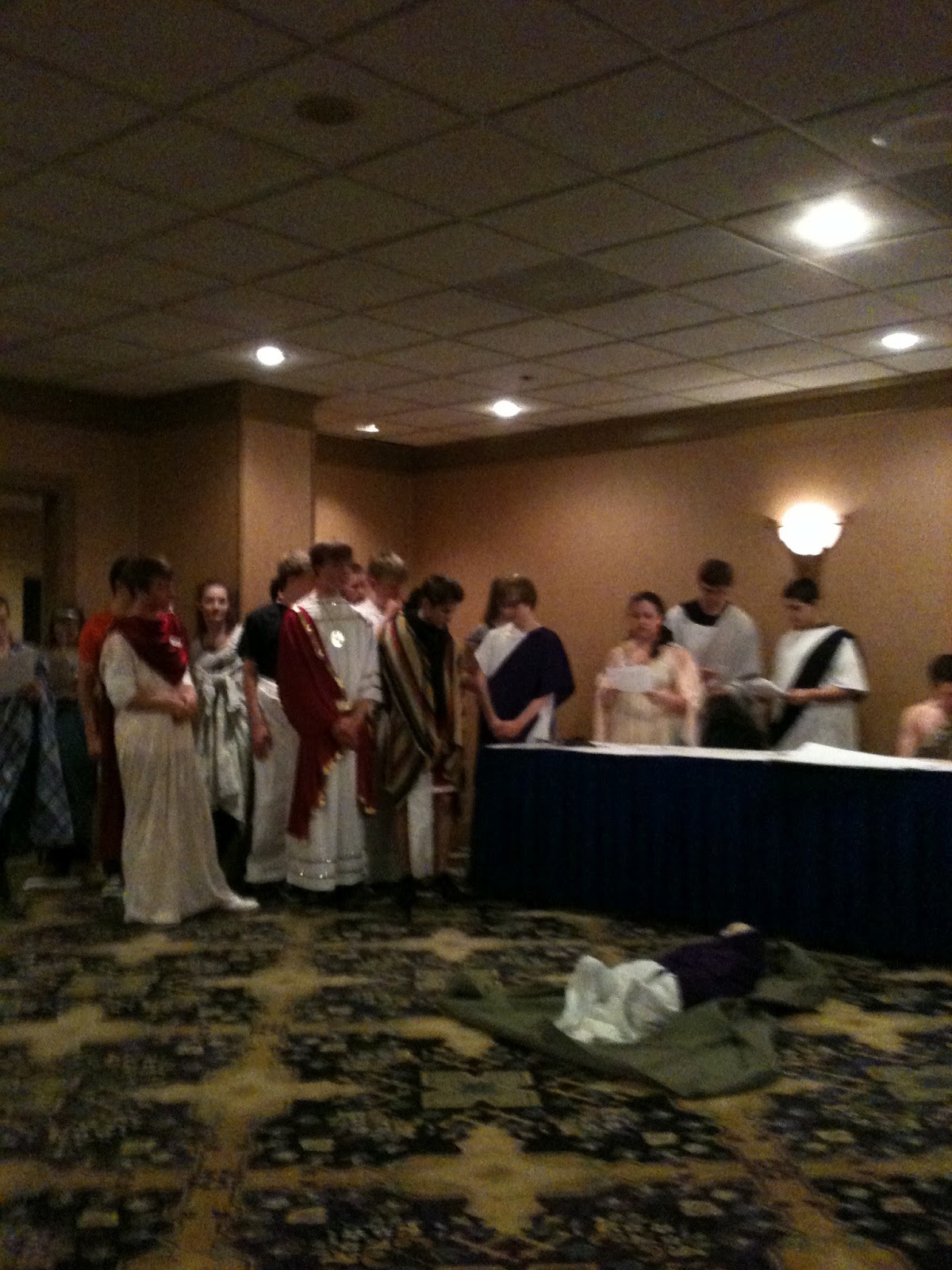
My "team" favorite were the "priests" carrying a shrouded Vestal Virgin to her death chamber. They had caught her, they announced, outside in the hallway with her boyfriend. Ha!

I also loved the Funeral Procession re-enactment, complete with dead body/creepy wrapped mannequin (that's the spot on the floor--sorry the photo is so dark!). I'd secretly hoped some of the kids would let it rip as professional mourners--Romans paid to wail and screech and pull out their hair in honor of the dead.  But they left that out, likely afraid that the hotel staff might call 911 on 'em.

The procession--including "family members" wearing death masks of ancestors--was a serious and solemn affair. The ancient Romans would've been proud.

Although I love doing school/author visits and giving students tours of the Greek/Roman galleries at the Carlos Museum of Antiquities at Emory University, I think I love working with the folks from the JCL the most. 

Go JCL!


Friday, January 20, 2012

Friday Funnies--Ancient Style

This Week's Theme: Ridiculous Ads
using Ancient References

(Though it helps if you're an arrogant jerk!)


(I've heard of white-washing history, but that's ridiculous!)


("Will you be super-sizing that?")


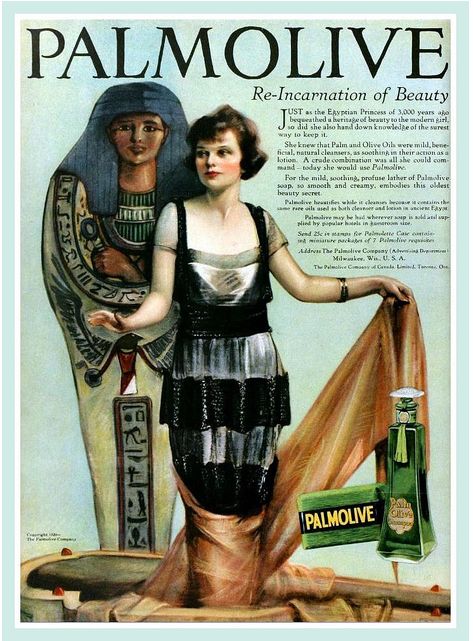
(Because pimple creams and ancient mysteries go so well together!)

Thursday, January 6, 2011

What the Romans Would’ve made of Dead Birds Falling from the Sky


The Romans would have wondered
why the gods were angry at them. 

If thousands of birds had fallen from the sky in ancient Rome, everybody—from emperors, to warriors, to peasants and slaves—would have been in a state of complete and total panic.

Cries of “Bad omens! The gods are angry! Terrible, terrible things are about to happen!” would reverberate throughout the empire. Everyone would stay home and bar the doors. Lawmakers wouldn’t convene. Schools would shut down. And the streets would run with blood as priests offered animal sacrifice after sacrifice to appease the gods.

Today, some religious leaders are reacting in similar ways (sans the animal sacrifices, of course): trying to divine spiritual meaning from events in nature.  “God is angry,” some claim about the thousands of birds falling from the sky in Arkansas. “We must change our behavior to appease him,” say others.  Still others maintain that this is the first sign of the apocalypse or end of the world.

Biologists tell us that large numbers of animal “die-offs” are not uncommon. The fact that the birds in Arkansas died on New Year’s Day, however, seemed to have pressed our “primitive, ancient” reflex of trying to make sense of what we don’t understand. We wonder: what does it mean that so many died? And why on New Years Day, of all times? Surely it’s a sign!

The ancient Romans constantly looked for signs from nature to understand their world. This tendency grew more fervent when they felt particularly vulnerable. So, for example, when the Carthaginian general Hannibal rampaged through Italy in the early third century BCE, the Romans “saw” portents of doom at every turn.  Birds falling from the sky would’ve been the least of them. Many claimed they saw: 
Victim of Pompeii, probably still wondering--at the
time of his death--what it "meant" that Vesuvius blew.

  • Snakes jumping out of the sea
  • Wheat stained with blood
  • A talking cow
  • Soldier’s spears bursting into flame
  • Unlit cauldrons coming to boil
  • A pig born with a human head
  • A baby born with an elephant’s head

Even if we don’t want to admit it to ourselves, we are all, on some level, on “high alert” for other “signs” from nature. Because despite our scientific advances, we still have the legacy of the frightened ancient person inside of us asking, but what does it mean?

And will we survive it?

The more things change, the more they stay the same.

Wednesday, July 7, 2010

The Pallor of Ancient Slaves

When we Americans think of slavery, we think of the heinous history of abuse perpetrated onto the peoples of West Africa during the 16th through 19th centuries

But in the ancient world, the majority of slaves were not African, but European.Few came from Africa at all. Why? Because slaves came from the regions Rome conquered and Rome never ventured further into Africa than Egypt and areas in today’s Algiers and Morocco.

As a result, most Roman slaves came from Greece, France, Spain, Germany, Turkey, Britain, Bulgaria, Romania, and even some of the outlying areas of Italy itself.

Why is the racial composition of ancient slaves useful to remember when talking to kids about history? Because, especially in the US, the default “picture” of slavery is of the people taken from West Africa.

Does it help to know it wasn’t always that way? That Rome never conquered (or even attempted to conquer) the powerful kingdom of Nubia, and that, therefore, there were relatively few ancient Nubian slaves?

The relevance to today’s understanding of slavery is important, I believe, because it addresses the specific (though often unconscious) American misperception—that all slaves were black and that this was true throughout history.

It’s like when I talked to my kids about the Holocaust. Being Jewish, I saw the panic in their eyes when they first learned about it—“Will they do this to us? Why do people hate us so? Are we vulnerable?”

I told them that attempted genocide was not a unique experience to the Jews but that sadly, it’s the story of mankind. From indigenous people to specific groups in Cambodia, Bosnia, Rwanda and, currently, Darfur, attempted genocide is not a Jewish problem but a human one.

Similarly, my hope would be that children studying history would learn that slavery was not only the victimization of a single people during a specific period of time, but a terrible reality throughout all of history. A reality that still continues today in pockets of the world. A reality that we are all obligated to help destroy once and for all.

For more info on modern slavery, go to: www.freetheslaves.net/


Thursday, June 24, 2010

The Ancients where ‘Whizzes’ at Bleaching Teeth

The earliest Egyptians cleaned their teeth with powdered ox hooves, myrrh, eggshells and pumice. How they applied such a yummy mix of flavors and textures to their teeth is unknown.

Ancient Romans scrubbed their choppers with a toothpaste made of rock salt and nettle (a variety which the Romans used to polish glass). They probably threw in a fragrant flower or two to make their breath sweet.

But for some, it wasn’t enough to just have clean teeth. They wanted smiles that dazzled. So they washed their teeth with…(wait for it)…human urine.

What, you didn’t know pee-pee has bleaching properties? How do you think those fancy Romans got their togas so bright-white and erm,…pisstine?

The Roman poet Catallus made fun of a man with one of these whizzy, Hollywood-like grins. Here’s how he ends his poem, “The Smiling Spaniard”:

...you rub your teeth and gums until they are red, so that the more polished those teeth of yours are, the more urine they proclaim you drank.

Oh, snap!

Think about that the next time you're considering bleaching your pearly whites. But hey, at least our modern ways won't leave you with such a horrible taste in your mouth!

Tuesday, June 1, 2010

Oh for Crying Out Loud!

Some ancient Romans cried into little glass bottles when in mourning. Once filled, they left the tear-shaped vials in the tombs of the newly departed as a sign of respect.

But for others, it wasn’t enough to have family members cry into their cups. Professional mourners were available to wail, moan and tear out their hair in honor of your terrible loss. And for an extra coin or three, they could be convinced to cry into little vials too.

Sandy Fry, one of my awesome critique group partners, introduced me to tear catchers. I had not heard of them though I’ve since learned they were common in the first century CE.

The practice survived into the Middle Ages and beyond. During the Civil War, it was said that some women cried into tear catchers and saved them until their husbands returned from battle. In the Victorian Era, some tear bottles were made into the shape of cigars so men would not be embarrassed to use them.

It seems like a strange though touching custom. But certainly not—as some have hinted—a vial one. (Hey don’t groan at me—that was Sandy’s pun!)

Tuesday, March 24, 2009

"I Swear On My Plums..."


Occassionally I hear the claim that ancient Roman men swore on their...um..."plums" before testifying in court. Could it be true--is there a "testes/testify" connection?

I've read different opinions but the consensus seems to be that it didn't quite happen that way.

Here's where the confusion may have begun: the word testicle apparently, comes from the Latin testiculus, a diminutive of testis. If testis meaning 'witness' and testis meaning 'testicle' are indeed the same word, then the etymology could be that the testicles are 'witness' or evidence of 'manliness.' (Only the extremely macho would turn their anatomy into "witnesses" of their own manly magnificence--or diminutiveness as the case may be--but that's another post).

I've also read that the origin of this swearing on the fruit of your loins thing came from the ancient Hebrews. Some site Genesis 24 where "Abraham said to the oldest servant of his house, who ruled over all that he had, 'Please put your hand under my thigh, and I will make you swear by the Lord..."
Some claim translators changed the original wording because well, swearing on someone's plums--not matter how ripe--is just plain weird. Not to mention funny.
I've said all along that nothing beats history for humor--the truth is always funnier than fiction!